 |
Cubillas de Rueda Town HallVillapadierna is a town belonging to the municipality of Cubillas de Rueda, in the province of León in the Autonomous Community of Castilla y León. It is located in the north of the province and is 51 km from the capital of León and 5 km from its town hall. This region south of the Cantabrian mountain range is believed to have belonged to the Vadinienses tribe, who fought against Roman troops in the Cantabrian Wars, until they eventually accepted their rule and culture. The terms paternus and maternus were used in the Middle Ages as personal names, "Padierna" derived from paterna, so Villapadierna means paternal town or town of Paterno. |
Mostrando entradas con la etiqueta León. Mostrar todas las entradas
Mostrando entradas con la etiqueta León. Mostrar todas las entradas
7/8/24
Villapadierna
30/12/23
Castle of Villanueva de Jamuz (León)
 |
North view of the castleThe castle of the Quiñones was built throughout the first half of the 15th century at the initiative of Don Diego Fernández de Quiñones, the future Count of Luna from the year 1462. It has a quadrilateral plan, with towers in three of its corners. In its north-east wall there is a central cube where the entrance to the castle is located and an ashlar on which the weapons of D. Suero de Quiñones, the protagonist of “El Paso Honroso” in Hospital de Órbigo, are sculpted, which reads the phrase “Honor or end.” Inside is the parade ground and the homage tower, with the heraldic shields of Don Diego and his wife María de Toledo. It had four floors and was crowned with a projecting cornice supported by modillions. The first floors served as the lords rooms and rest chambers. |
Villanueva de Jamuz
 |
Town Hall of the Santa Elena de JamuzVillanueva de Jamuz is a town belonging to the municipality of Santa Elena de Jamuz, in the province of León in the Autonomous Community of Castilla y León, it belongs to the Tierra de La Bañeza region. The town would have been founded around the 11th century, where it is already documented. At first it was known as Villanueva de Don Vermúdez, a figure of the Leonese nobility, and during the 13th and 14th centuries it was renamed Villanueva de Simón Sánchez, a relative of the previous Vermúdez. From this century onwards, Villanueva, together with nearby towns, became the Council or Jurisdiction of Valdejamuz in the hands of the powerful family of the Quiñones-Counts of Luna, in turn relatives of the previous ones. |
29/6/23
Castle of Grajal de Campos (León)
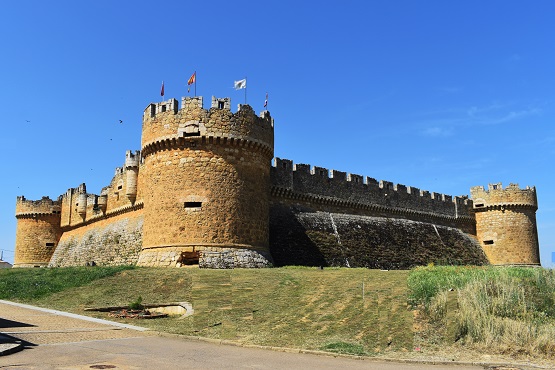 |
Eastern view of the castleThe castle of Grajal de Campos is a military construction from the 16th century, designed by the architect Lorenzo de Aldonza on the remains of another previous castle from the 10th century. It is considered the first artillery castle in Spain. It was built between 1517 and 1521 by order of Hernando de Vega, and finished by his son Juan de Vega, first count of Grajal de Campos. It has a quadrangular plan with four towers where the largest caliber cannons were located. In the past, it was isolated by a moat with a drawbridge and an entrance door, all of which is currently buried, and its exact location has not been found. According to an 18th century manuscript, it was located on the southern side of the complex. It is built on a pronounced slope and the mote itself and the rubble were used to embank the indoor of the fortress and achieve the current platform that surrounds its walls. |
12/12/22
Castle of Laguna de Negrillos (León)
 |
Western view of the castleThe castle of Laguna de Negrillos already existed around the year 1205, the date on which King Alfonso IX of Leon granted a charter to the population. The reconstruction of the castle as we see it today was carried out by Don Diego Fernández de Quiñones and Doña María de Toledo, in the 15th century. It is located in the Páramo leonese region and is 42 km away. of Leon capital. It has a square plan and has a homage tower with five floors and all battlements at the top, in the north-west outer corner and a rectangular tower called the Queen's tower in the north-east interior of the parade ground. |
Laguna de Negrillos
 |
Town HallLaguna de Negrillos is a municipality in the province of León in the Autonomous Community of Castilla y León, located to the south of the Páramo Leonés region and very close to the Órbigo and Esla rivers, passing through it a small stream, called Regueral. During the twelfth century under the reigns of Fernando II and his son Alfonso IX, the name as such of "Lacuna de Negrillis" was mentioned repeatedly, the town being handed over to Suero Rodríguez. In 1205 Alfonso IX grants it a charter to the town, in which most of the precepts contained in it present a notable similarity with those of the charter of León capital. |
12/3/20
Castle of Valencia de Don Juan (León)
 |
South-east view of the castle The Coyanza castle owes its name in honor of the name with which it was known during the 11th and 12th centuries to Valencia de Don Juan, Coyanza, an ancient town of Roman origin. It was built in the 15th century by the Acuña, Counts of Valencia, on an Iron Age fort, and on the ruins of a previous fortress, destroyed by Almanzor in 996. It consists of a moat, an bulwarks and the great crenellated wall with triple cube towers. The homage tower rises to the south and houses the Castle Museum inside an iron, wood and glass building. |
Valencia de Don Juan
 |
Main Square Valencia de Don Juan is a municipality in the province of León in the Autonomous Community of Castilla y León. It is located between the valley of the river Esla and Los Oteros, within the Esla-Campos region. It was called Comeniaca in Roman times, and in the Middle Ages it was called Coyanza, a name that lasted until the 13th century when it was changed to its current name in honor of the first Duke of the town, the Infante Juan de Portugal, son of the Lusitanian king, Pedro I and Inés de Castro. The municipality was the seat of the Council of Coyanza, summoned by King Ferdinand I and which established rules of coexistence and religious for the subjects of their kingdoms. |
15/11/15
Castle of Villafranca del Bierzo (León)
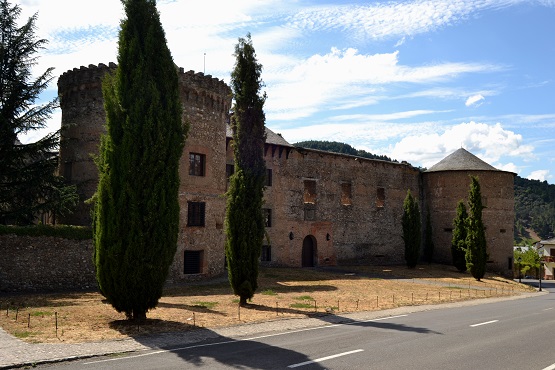 |
| View of the castle from the south-east
The castle of the Marquis of Villafranca was rebuilt towards the year 1515 by Pedro Álvarez de Toledo y Zúñiga, over other previous known with the name of "Force", destroyed in 1507 by the illegitimate son of the first Earl of Lemos, Pedro Álvarez Osorio. It has quadrangular shape with four towers at the corners, being south-west angle of homage tower.
|
8/7/15
Alija del Infantado (León)
 |
| South-east view of the castle
The castle of Pimentel or Dukes of Infantado was built in the 15th century on the primitive Ponces Palace from the 13th century. It has a square shape with two towers on the wall and cubes in the angles, being flanked by a gothic arch door semi-covert by an attached building.
|
7/7/15
Alija del Infantado
 |
| Panoramic view of the village from the source of San Ignacio
Alija del Infantado is a town in the south of the province of León in the Autonomous Community of Castilla y León. It belongs to the land of La Bañeza comarca and its municipal area is bathed by the river Órbigo. There are also several mineral sources, used since ancient times.
|
Suscribirse a:
Entradas (Atom)