 |
South-east view of the castleThe castle of Polán was built around the 12th century, as it is mentioned in 1116 during a battle between the Christians of Toledo and the Muslims of the town of Oreja. Two towers are preserved, which is considered to be a huge fortress. The tallest is presumed to be the homage tower, in which a four-storey distribution can be seen inside, and above the last the start of a vault. In the jambs and lintels of some of its windows appear various engravings related to east symbolism and the Templar orders. It belonged to the poet Lope Ortiz de Zúñiga around the 15th century and it is known that in the 19th century, it was owned by the Marquis of Cerralbo. |
Mostrando entradas con la etiqueta Autonomous Community of Castilla-La Mancha. Mostrar todas las entradas
Mostrando entradas con la etiqueta Autonomous Community of Castilla-La Mancha. Mostrar todas las entradas
5/3/22
Castle of Polán (Toledo)
Polán
 |
Town HallPolán is a municipality in the province of Toledo in the Autonomous Community of Castilla-La Mancha, it is located in the Montes de Toledo region. Polán's toponym is related to populating or action of populating, reaching its current name through the Mozarabs, Christians who remained in Muslim territory after the encroachment of the Iberian Peninsula. In the centuries up to the 18th century, Polán became one of the most important towns in the area, with the forests of Ventosilla, Las Morras, Fuente del Caño and Zuarraz, together with its orchards of fruit trees, vegetables and barley, its vineyards and olive groves. |
8/12/20
Castle of Cebolla (Toledo)
 |
North-east view of the castleThe Cebolla castle, also called Villalba castle (White City), was built on an old Roman fortress by the Arabs, during the 11th and 12th centuries, passing after the reconquest to the Order of the Temple. It is currently owned by the Earls of Deleytosa and is in a state of total ruin. It has an almost rectangular plan and remains of an outside barrier can be seen. It does not have a homage tower but it would have rectangle towers in its corners, of which only remains of one of them remains, in the left corner of the main facade. If it keeps towers in the center of its sides. Its indoor is totally destroyed. |
Cebolla
 |
South view of the townCebolla is a municipality in the province of Toledo in the Autonomous Community of Castilla-La Mancha. It is located between two hills in the region of Torrijos. The Tagus river runs through its term, passing about three kilometers south of the town. The first written document in which the town appears, is in a Mozarabic text from 1184, in which the existence of a farmhouse or set of farmhouses is related, which would be formed by the farmsteads of La Aldehuela, Villalba, Sanchón and Las Casas of Cebolla. |
2/12/17
Castle of Saelices (Cuenca)
 |
| South view of the castle
The castle of Luján is of Renaissance and Plateresque style, being built in the middle of the XVI century. It is known that the Crown exchanged it in the year 1571 for the salt well of Gormellón in Atienza to Gaspar Ramírez de Vargas, governing of Madrid. It was a pentagonal plant with a moat surrounding the fortress except on the west side. It had an entrance bastion and six towers, plus a turret attached to the north door.
|
1/12/17
Saelices
 |
| Town Hall
Saelices is a municipality in the province of Cuenca in the Autonomous Community of Castilla-La Mancha. It is located in the region of La Mancha. It is likely that its foundation is due to the proximity of the spring called Fuente Lamar, where the aqueduct that supplied water to the nearby Roman city of Segóbriga, after being abandoned by the Muslim invasion.
|
22/6/17
Castle of Cuerva (Toledo)
 |
| North-east view of the castle
The castle of Peñaflor was probably built during the reign of Alfonso X the Wise, in the 13th century. Being acquired by the governor of Cazorla don Juan Carrillo in the 15th century. It was built with a rectangle floor plan and now kept three circular towers at its corners. It contained an round path around the upper perimeter of its walls, of which remain only the machicolations. It seems to be that it had not homage tower or moat which could protect the castle.
|
21/6/17
Cuerva
 |
| José Antonio square
Cuerva is a municipality of the province of Toledo in the Autonomous Community of Castilla-La Mancha. It is located on a hill in the region of Montes de Toledo. In the year 1220 the town is named El Villar de Corva, passing through the years with the names of Peñaflor, Villacarrillo and the current Cuerva, a term derived from the latin corvus, raven.
|
21/4/16
Castle of Almonacid de Toledo (Toledo)
 |
| East view of the castle
The castle of Almonacid dates back to the year 848 and is of muslim origin, being strategic point of surveillance on a hill of the mountains Nambroca. It has irregular polygon shape and its walls are high and battlemented, protected by an outer barrier with a round path in its entirety. In the inside is located the homage tower in the courtyard of arms.
|
26/2/16
Castle of Puebla de Almenara (Cuenca)
 |
| View of the castle from the south-east
The castle of Almenara, also called Santiago de Jalamena, is a fortress rebuilt between the XIV and XV centuries on a previous arab from the 12th century, which passed into christian hands in the year 1177. It consists of three walled enclosures, being the first, the outermost more modern and retains his indoor enclosure in the homage tower, the central courtyard with cistern, cellars and stables.
|
25/2/16
Puebla de Almenara
 |
| Main Square
Puebla de Almenara is a municipality in the province of Cuenca, in the Autonomous Community of Castilla-La Mancha. Its foundation dates from the year 1332 by the first Duke of Villena, the Infante don Juan Manuel. It is located in the sierra de Almenara or Jaramena, where the nearby remains of a celtiberian castro on the hill of the cross.
|
6/12/15
Castle of Mascaraque (Toledo)
 |
| South view of the castle
The castle of Juan de Padilla is a building of the 14th century of islamic origin, being subsequently during the centuries XV and XVI rebuilt and refurbished. It is on the inside of the town and its plant is quadrangular and its height scarce, since it was topped deliberately at the beginning of the modern age, probably by the Catholic Monarchs.
|
5/12/15
Mascaraque
 |
| Constitution Square
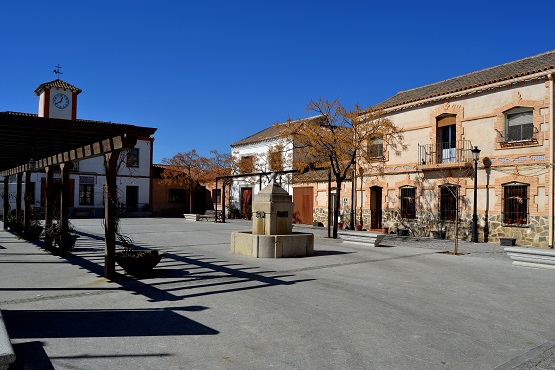
Mascaraque is a municipality in the province of Toledo, in the autonomous community of Castilla-La Mancha. It is located in the central area of the province and belongs to the region of the Montes de Toledo. Up to this town becomes the route of Don Quixote on his route from Toledo to San Clemente, starting from Mascaraque three sections.
|
2/10/15
Castle of Torija (Guadalajara)
 |
| View of the castle from the square of the Villa
Its foundation is believed was templar, but in the 15th century its reconstruction was the work of the Mendoza family. Currently inside it houses the CITUG (Guadalajara Tourism Interpretation Centre) and the museum of the book "Journey to la Alcarria" by the prize Nobel Camilo Jose Cela is located in the homage tower.
|
1/10/15
Torija
 |
| Panoramic view of the population
Torija is a town in the province of Guadalajara, in the Autonomous Community of Castilla-La Mancha, also known as "La Puerta de la Alcarria". Its location as a junction of roads and natural traffic to Aragon, has done that since time immemorial, the presence of man be presumed in their environment.
|
11/8/15
Castle of Zorita de los Canes (Guadalajara)
 |
| View of the castle
The castle of Zorita de los Canes, also known as the Alcazaba de Zorita was built at the end of the 9th century by the cordoban emir Mohamed I, using stones from of the city nearby visigothic of Reccopolis for its construction. The castle adapts to the hill on which is erected, and is divided into two zones, one ecclesiastical and other military.
|
2/5/15
Castle of Barcience (Toledo)
 |
| South-east view of the castle
The castle dominates the population of Barcience from a hill since it was built by the Silva family in the 15th century. It is almost square floor and stand out above all the homage tower and a huge print of a lion rampant representing the heraldic emblem of the Silva family.
|
1/5/15
Barcience
 |
| View of the town from the castle
Barcience is a town in the province of Toledo in the Autonomous Community of Castilla-La Mancha. It is possible that your foundation is due to the tribe of Celts becoming subsequently a hispanic villa romana as reflected in certain stone vestiges.
|
Suscribirse a:
Entradas (Atom)